Lazy AI Side Hustles That Pay Daily — 11 Real Ways to Earn with AI Art & Design
AI has quietly turned digital art into one of the most accessible income streams on the internet. You don't need to draw. You don't need design school. You need a free AI tool, a few hours a week, and a marketplace account. These are the actual AI side hustles working right now — not theory, not hype.
AI SIDE HUSTLES
Rachel
4/16/20265 min read
The phrase "passive income" gets thrown around a lot, but AI-generated products come closer to the real thing than almost anything else. You create a design once. You upload it. People find it and buy it — sometimes while you sleep, sometimes while you're at your day job, sometimes on a random Tuesday for no obvious reason.
Below are 11 AI design side hustles that are working right now. Some will surprise you. A few you've probably never considered. All of them are genuinely low cost to start.
1. AI Storybook Illustrations
Similar to Amazon KDP low-content books — but with more depth
Think of this as a step up from the typical low-content book. Coloring books, planners, and joke collections take almost no effort — storybooks require a little more, but the payoff is bigger. AI image tools let you generate consistent characters across pages, something that used to require a professional illustrator. Pair your visuals with a simple story (even a children's story written with AI assistance), format it in Canva or Book Bolt, and publish directly to Amazon KDP. The barrier is low; the upside is real.
2. AI Wall Art
Etsy + Pinterest = a powerful free marketing combo
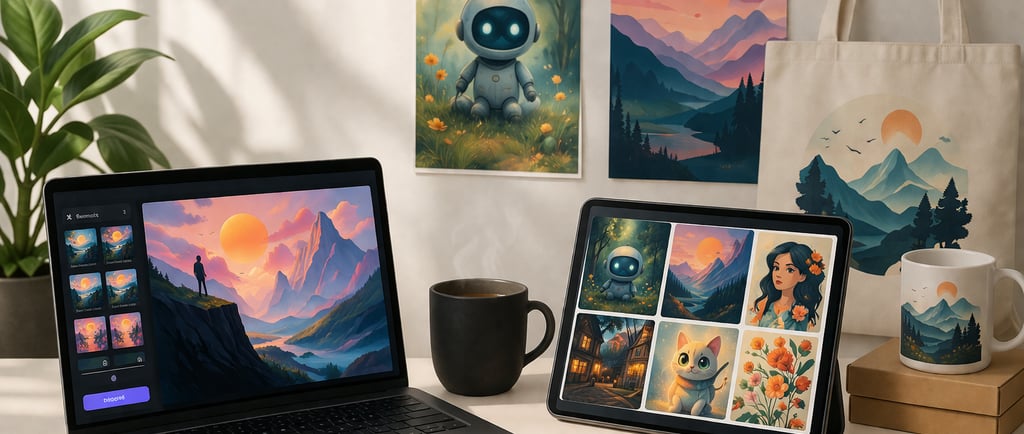
Wall art is one of the most proven AI side hustles out there. People constantly redecorate — new homes, new aesthetics, new moods — and digital wall art fills that demand affordably. Etsy is the platform of choice here because buyers actively search for it. Pinterest is where you drive free traffic that compounds over time. A single well-performing pin can send buyers to your shop months after you posted it. The profit margins on digital downloads are as close to 100% as it gets — your only real cost is your time.
3. AI Clipart Packs
Trendy niches on Etsy, evergreen niches on microstock
Clipart is one of the unsung heroes of the AI design world. The strategy here is actually two-layered: on Etsy, you ride trends — seasonal clipart, niche themes, whatever is hot right now. On microstock platforms (Adobe Stock, Shutterstock, Freepik, Depositphotos), you publish evergreen packs that sell quietly for years. The key difference is intent. Etsy buyers are often crafters and small business owners looking for something specific right now. Microstock buyers are designers looking for reusable assets with no expiry date.
4. AI Illustrations for Microstock
Upload once, earn passively across multiple platforms
Microstock is a long game, but it pays. Upload simple, clean AI illustrations to Adobe Stock, Shutterstock, Depositphotos, and Freepik simultaneously. Your catalogue grows month by month, and so do your royalties. The key to success here is volume and consistency — 10 uploads won't move the needle, but 500 well-tagged illustrations will. Focus on commercial use themes: business concepts, lifestyle, technology, nature. These sell across industries and don't go out of style.
5. AI Business Cards
Repeat buyers, bundle sales, and a niche that keeps giving
This one might be the most underrated hustle on this list. Business cards sell almost every single day when you pick the right niche and promote consistently. The magic is in the repeat purchase cycle — people run out of cards and come back. They recommend you to others in their industry. Bundles work particularly well here because buyers in professional niches (real estate, beauty, fitness) often want matching social media templates, letterheads, and thank-you cards. Instagram is ideal for showcasing these, especially in B2B-adjacent niches where people actively look for professional branding inspiration.
6. AI Tapestries
Low volume, surprisingly high profit — a sleeper hit
Nobody expects to make money on tapestries. But print-on-demand platforms like Redbubble and Society6 let you list them for free, and when they sell, the margins are significantly higher than a t-shirt or mug. Sports-themed tapestries in particular seem to have a loyal buyer base. The challenge is marketing — this isn't an impulse buy, it's a considered purchase. Once you figure out how to reach the right audience (niche Facebook groups, Reddit communities, themed Pinterest boards), this hustle has real room to grow.
7. AI Invitations
Zazzle is the platform — and it delivers daily
Invitations are an event-driven purchase, which means demand never really dries up — birthdays, weddings, baby showers, graduations, retirements. Zazzle has built a specific audience for this category, and once your designs are live, the platform does the heavy lifting. Focus on customisable templates where buyers can personalise names and dates — these convert far better than fixed designs. Wedding and birthday niches are the most competitive but also the most searched. Consider going deeper into sub-niches: retirement parties, quinceañeras, gender reveals.
8. AI Posters
A sceptic turned convert — and the sales proved it
Posters are one of those products that can feel too broad to niche into — until you realise how specific buyers actually are. Motivational posters, vintage travel prints, sports team tributes, educational diagrams, film-inspired art — the categories are almost endless. The shift that makes posters work is treating them as a niche product, not a generic one. A "retro 1970s national park poster set" will consistently outperform "nature poster." Think series and collections rather than one-offs, and list on Etsy, Redbubble, and Society6 simultaneously.
9. AI Coloring Books
Amazon KDP is doing the heavy lifting here
Coloring books are still one of the most reliable products on Amazon KDP. Adults color for stress relief. Kids color because it's fun. And AI tools now generate clean, printable line art in minutes. The trick is targeting specific audiences: mindfulness coloring for adults, dinosaurs for 4-year-olds, anime for teens, mandalas for travelers. Creative Fabrica and Etsy are also viable platforms, but KDP's built-in search traffic and Prime audience make it the strongest single platform for this product type.
10. AI Pattern Designs Bonus
Seamless patterns sell on fabric, wallpaper, and merchandise
Seamless repeat patterns are in high demand across multiple platforms — Spoonflower (fabric and wallpaper), Surface Pattern on Creative Market, and print-on-demand merchandise. AI tools are remarkably good at generating cohesive patterns, and once you have a strong set, you can apply the same design across dozens of products. Floral, geometric, animal, and seasonal patterns all have consistent buyer bases. This is a great crossover hustle if you're already selling clipart or illustrations.
11. AI Canva Templates Bonus
Small businesses and creators are your buyers
Small businesses need professional-looking social media posts, pitch decks, menus, and media kits — but most can't afford a designer. AI-generated Canva templates fill that gap perfectly. You can sell these on Etsy, Creative Market, or even your own Gumroad store. The buyer is often a solopreneur, coach, or local business owner who wants something that looks polished without the price tag. Social media template bundles (30 Canva templates for Instagram Reels, for example) consistently perform well and invite repeat purchases as businesses update their branding.
Which one should you start with?
The honest answer is: the one that matches what you already know or enjoy. If you understand a specific niche — sports, weddings, fitness, pets — start there. Niche knowledge is genuinely your biggest competitive advantage, even over design skill.
If you're starting completely fresh with no niche in mind, wall art or coloring books are the lowest-friction entry points. Both have proven demand, both work on free platforms, and both give you fast feedback on what resonates.
The most important thing is to pick one, not five. List 10–20 products. See what gets traction. Then double down on what's working before you expand to the next hustle.
Start small. Stay consistent. Let the platform work for you.
Use the free Side Hustle Income Calculator to estimate what your AI design shop could realistically earn based on your hours and pricing.
Who buys these:
Coaches, real estate agents, fitness instructors, and food bloggers are among the most active Canva template buyers. Design specifically for one of them and price accordingly.
Seasonal spike: Upload graduation and wedding invitation designs in January–February so they're indexed and ranking by the spring rush.
Bundle idea: Offer a "full brand kit" — business card + social media template + email signature. Charge 3–4x what you would for the card alone. Buyers love the convenience.
Realistic expectation: Microstock income typically starts slow but becomes meaningful at 300–500+ assets. Think of it as building a library, not making a quick sale.
What works: Minimalist line art, botanical prints, and quote-based designs consistently perform. Niche down — "coastal grandmother aesthetic" will outsell "generic art print" every time.
Pro tip: Seasonal storybooks (Christmas, Halloween, back to school) spike in sales predictably every year. Create them once, earn for years.
Low Cost Hustle
Helping people make money online with simple side hustles, practical guides, and free tools.
About
Links
© Low Cost Hustle 2026. All rights reserved.